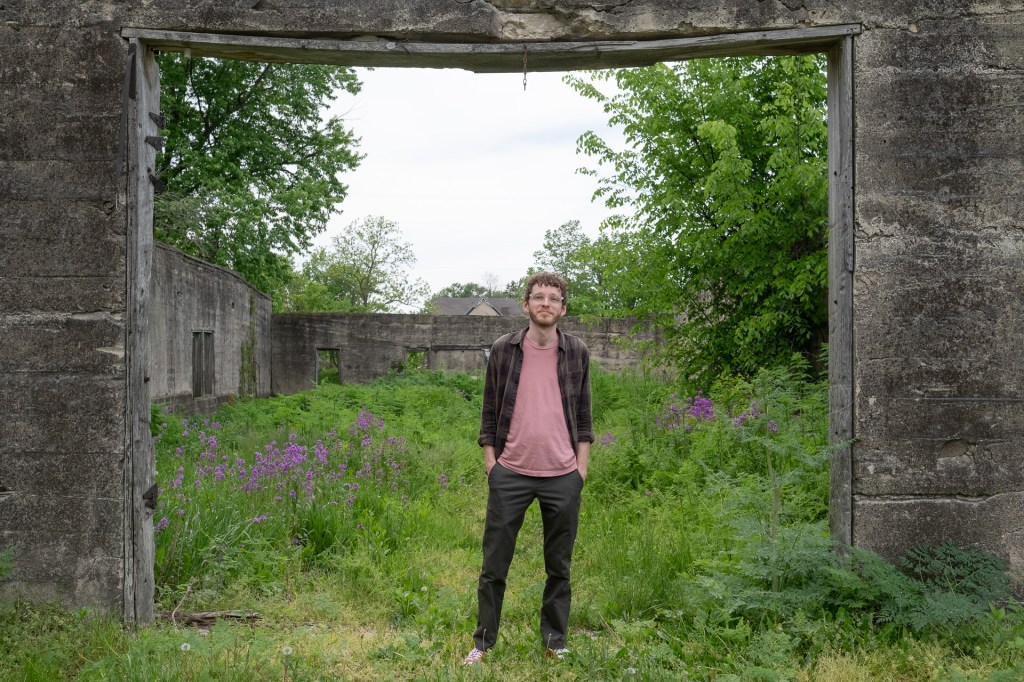
Matthew Moore is a writer, PhD student, and lifelong Midwesterner. Raised in a small, rural town boasting a single two-line highway with no traffic lights to boot, Matthew’s nonfiction writing and research explores the ruination of regional ecologies, the politics and history of emotion, and whiteness and social class. He holds an MFA in Creative Writing and Environment in creative nonfiction from Iowa State University. He is currently a PhD student studying American literature at Washington University in St. Louis, Missouri.
At WashU, Matthew currently studies representations of anger in late-19th and early-20th century American literature. From eugenicist race science to capitalist managerial science, Matthew’s research focuses on how representations of rage and wrath reflect cultural attitudes about race, heredity, and human impulse; representations that could either reproduce or resist social norms around impulse control and the racialization of instinct. In a long tradition spanning Moby-Dick to Native Son, from Edith Wharton to Ann Petry, Matthew is interested in how post-Darwinian literary treatments of anger exposed double-standards by which some indignation counted as righteous and other forms of anger were condemned as violence. Through this tradition, Matthew’s research proposes a new periodization of modern American literature. This project rethinks American Modernism by tracing the continuities of rage’s representation in literary Realism, Naturalism, and, finally, in the radical renovations under a Modernism that inherited both the problem of primal aggression and the dilemma between expression versus repression that had long agitated American life and culture.
Matthew is also at work on a nonfiction collection of personal prose, auto-ethnography, and literary criticism tentatively titled In Plain Sight: Essays on Pastures, Perception, and Picturing the Midwest. In this collection, he recounts his upbringing in rural Missouri in connection with a range of formative Midwestern regionalist and modernist writers from Hamlin Garland to Sherwood Anderson and Willa Cather. Through meditations on the personal, the historical, and the literary, In Plain Sight speculates on how the topographical flatness of plains, pastures, and prairies effected powerful expressions of human attention to nonhuman ecologies newly reconfigured by emerging infrastructures and economies of rail transport, roadmaking, and industrial agriculture.
His essays and public scholarship can be found in Rust Belt Magazine, The Pittsburgh Review of Books, The Mid-Theory Collective, and InVisible Culture.
Matthew is the convener for the Psychoanalysis Reading Group at WashU.
Find or contact him at mattmo-washu.bsky.social or email m.s.moore@wustl.edu
photography by Micheal Keatley

